

I hope everyone has had a great Summer!
908 Williamson developments have been very quiet, so I haven’t had much to write about since the last January post. Well things are picking up and I’ve had some time recently to do a little research and I think you’ll find the results of that VERY intreesting. I’ve gathered enough information to update everyone on, I’ve turned it into a 3-part series:
Part 1: Raleigh’s Townhome & Condo Market Is Under Extreme Distress (8/18)
Part 2: TBA - coming 8/25
Part 3: 908 Williamson court case(s) update.
Fundraising update:
Before digging in, you’ll find out in Part 3 that some court activity is picking up and our lawyer fees are going to be rising for the rest of the year. As a reminder (details here), we have a $10k match open, so the next $10k yields $20k
Deep Dive into Raleigh’s Townhome and Condo Market Dynamics
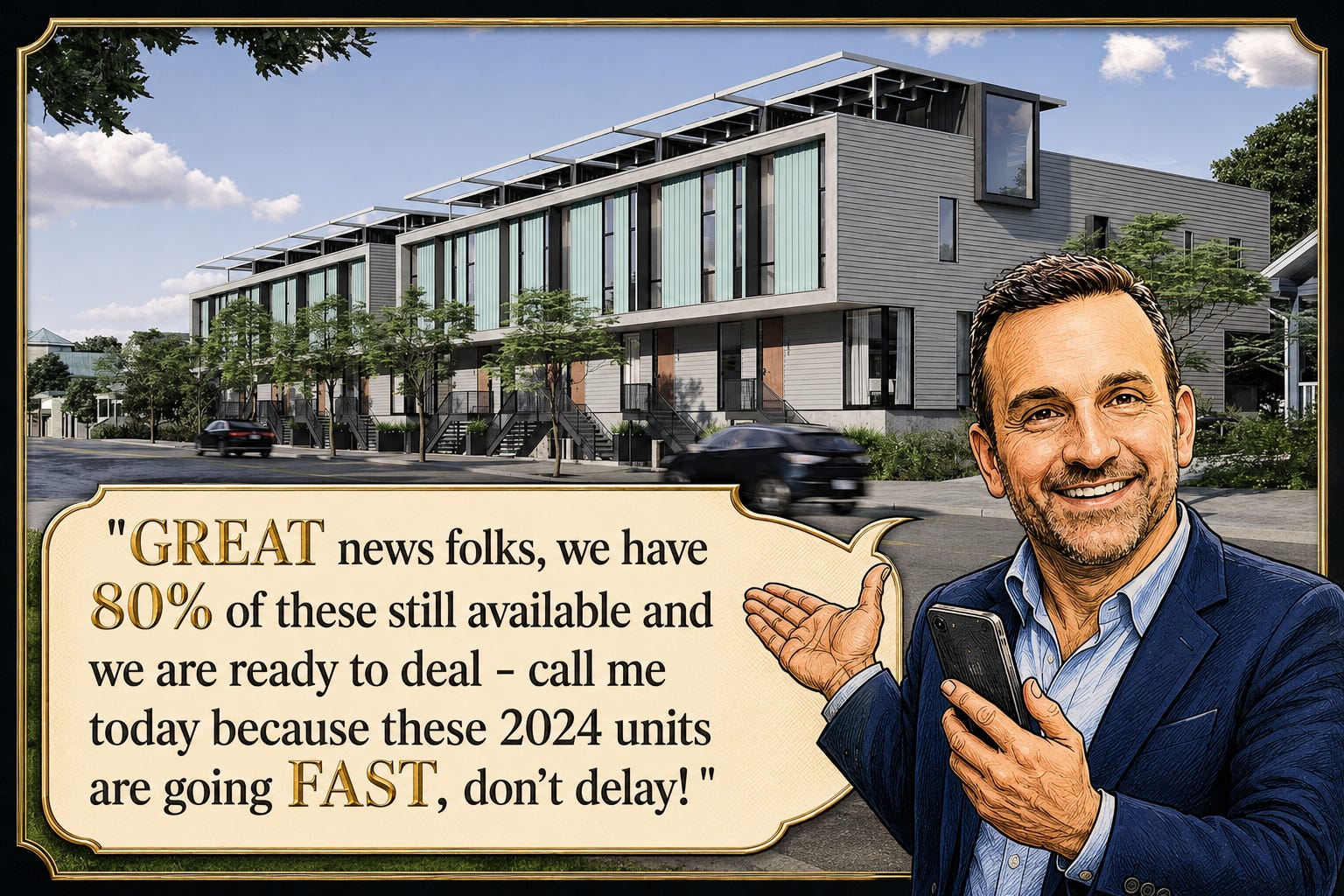
We spend a lot of time here on courtrooms and zoning codes. Today, something different: a macro market check-in. But there’s a method to the madness, like any economic situation you have to look at the Macro and the Micro - it’s a complex ecosystemm The rationale for buying 908 and cramming 17 ratchet townhomes onto the lot was born in the go-go top-of-the-market 2022 housing market, and it’s facing a very different situation out there.
Let’s dig in.
Raleigh’s Days on Market: Third-Worst Trend in America
Per the RE/MAX National Housing Report, Raleigh homes averaged 68 days on market in February 2026 . That’s up more than 30% year-over-year, the third-largest increase of any market in the country. Sales declined 3.7% year-over-year. This isn’t a Raleigh-is-doomed story; prices still inched up 2%. It’s a leverage story: buyers now have time, options, and negotiating power they haven’t had since before the pandemic.
That was the last time RE/MAX published, but by Realtor.com’s measure (median, a different yardstick than RE/MAX’s average), Raleigh days on market has climbed four straight months: 44 in April, 46 in May, 50 in June, 54 in July.
No matter how you slice it, in 4 short years we’ve gone from a seller’s market to a buyer’s market and the trend isn’t slowing.
Inventory: A Four-Year High and Climbing
The days-on-the-market stat is the output of a supply/demand imbalance, let’s keep peeling the onion to understand more about what’s going on.
Active listings in the Raleigh metro hit 5,963 in July 2026 per Realtor.com data tracked by the St. Louis Fed — up every single month this year (4,648 in March → 5,124 → 5,584 → 5,787 → 5,963). That’s a ~30% increase in supply from March to July - just 4 months.
Local analysts were already calling inventory a four-year peak back in January, and Triangle-wide inventory was up nearly substantially as far back as spring 2025. Raleigh’s average days on market had jumped from 23 to 45 in the twelve months before that. The trend is not new. It’s compounding and there’s now a supply glut jamming up the market and it’s burgeoning.
And the Big Nasty Soft Spot Is...
To summarize, we now know:
Days on market are expanding - third worse in the country.
Inside that datapoint, we discovered that available listings is exploding - setting multi-year records.
Let’s look inside that supply - what’s the piece that’s moving and what’s the piece that’s stagnant - the root cause of the problem?
Here’s the part that matters for our neighborhood. The weakness isn’t evenly distributed — it’s concentrated in what they label “attached product”. Local market analyses have flagged declining buyer interest and longer days on market specifically for townhomes and condos. And in March, Triangle Business Journal ran a piece on downtown Raleigh’s luxury townhomes getting price cut after price cut. Berkshire Hathaway agent Bo Bromhal put it bluntly: the buyers for these projects were the “big city” arrivals of 2018–2022, and in his words — “Everything down there has dried up.”
It’s not just Raleigh - over in Charlotte their local news is running stories about the townhome boom “backfiring” - a similar glut of attached homes chasing too few buyers.
Why This Matters for Hayes Barton
This hits us on two levels:
Super Micro: 908 Williamson
First, the 908 Williamson project: 17 townhomes at a reported $2M price point jammed into a 2.4 single home lot was conceived in the frothiest housing market in living memory. Every datapoint above says that market is gone. Rising inventory, record days-on-market growth, and a demand drought specifically for high-priced attached product is a brutal backdrop for the developers betting on it.
Medium Micro: Raleigh
The rise in supply is down-stream of a broken policy. This is worthy of a complete post, but in a nutshell, the logic goes:
The cost of housing is rising (they use median price data for Raleigh)
The only thing we can do is add a ton more supply
That will drive prices down! Simple, right?
Nope….
The above broken logic is what drove the broken and deceptively named ‘missing middle’ text changes that destroyed Raleigh’s previous 98 years of working zoning laws that created iconic neighborhoods across the city. The text changes are TC-5-20, TC-5-21 and TC-5-22. Remember the TC-5-20 is the one passed July 6, 2021 in the wee hours of the night under the cover of dark with no public input and is the center of one of our lawsuits.
Who’s Driving This? Let’s ask the Mayors?
To show you I’m not making this up, here’s a collection of quotes from both Mary Anne Baldwin and Janet Cowell:
Mary-Ann Baldwin
On WRAL, “I think it’s just trying new things and building up the supply. That’s going to make a difference.”
In her 2022 INDY questionnaire: “I believe the city needs to work directly — though investment and policies — and with our unique leverage to expand our housing supply and build more affordable housing.”
On WRAL, after the zoning changes: “The purpose of missing middle housing is to actually help increase the supply.”
In a 2024 Raleigh Magazine exit interview: “Bottom line is we don’t have enough supply.”
Janet Cowell
On WRAL, 2024, asked about affordable housing: “Supply, subsidy and stability are three components of affordable housing. And so, I think they’re attacking supply.”
To the INDY during the 2024 race: “…you’re going to have to use the market to pay for it, which means you’re going to have to have a fairly aggressive growth and development model.”
As mayor, to Enlace Latino: “Housing is the biggest issue, along with the cost of living. Every day, 60 people arrive in Wake County, and 30 move to Raleigh.” And: “We’ve been looking to Houston as a model because it’s allowed for more housing to be built.”
Let’s check in on this theory…
The code changes came in 2021, we’ve been building like crazy and as the data indicates above, we have solved the supply problem - supply is growing at a 30% clip and compounding. We’re at multi-year highs. Certainly the median cost is down at last 30%.
Good news the lasest Raleigh data is out→
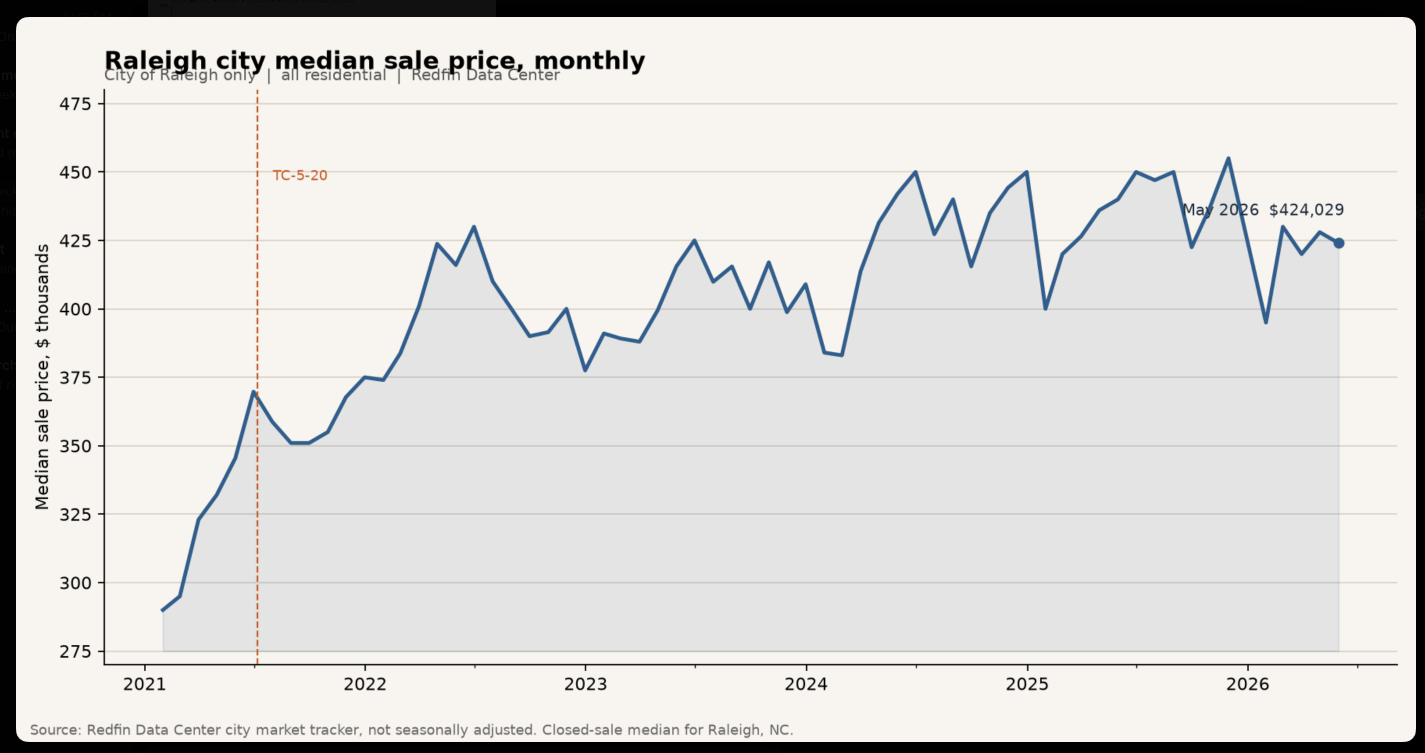
Wait… after a year of a glut and it’s, unchanged? 5 years of pedal-to-the-metal supply building and it’s not going down or really changing much at all - crazy right? Nope, obvious. This entire policy and crisis is complete hog-wash.
Why isn’t the glorious Missing Middle program working?
Those of you that have taken a college-level stats class know that medians are deceptive, there’s a million things that can be going on in here - for example, we learned above that inside the median supply data, the real problem spot is townhomes and condos once we went just slightly deeper.
Digging into why it’s not working is beyond the scope of this, but it points to the underlying misleading rationale and branding for this rule change.
Perhaps the median is going up because more afluent people moved to the area and purchased a mix of more valuable homes?
Why are smart people pushing development so hard, changing 98 year old zoning laws at midnight without review and pushing supply to the point of a glut with no end in sight?
Another weird one. I know both Mary-Ann Baldwin and Janet Cowell relatively well and they are very smart people. They understand advanced statistics and economic theory. But, they are also politicians and the machine that makes politics work is money (donations). I believe the answer to this question lies it the simple investigative principle: follow the money, which we’re going to do, but that’s a story for another day. Let’s stay focused on this townhouse and condo problem, because that’s our most pressing and interesting issue of the day.
Coming next…
Just how brutal is the supply glut? In Part 2, we’re going to go spelunking deep into county deed books, MLS listings, hidden Loopnet listings, corporation documents and more. What we found will shine the bright spotlight of transparency on what our adversaries at the 908 Williamson development team are up to and how business is going for them these days.
Bring some popcorn, it’s about to get spicy 🌶️